

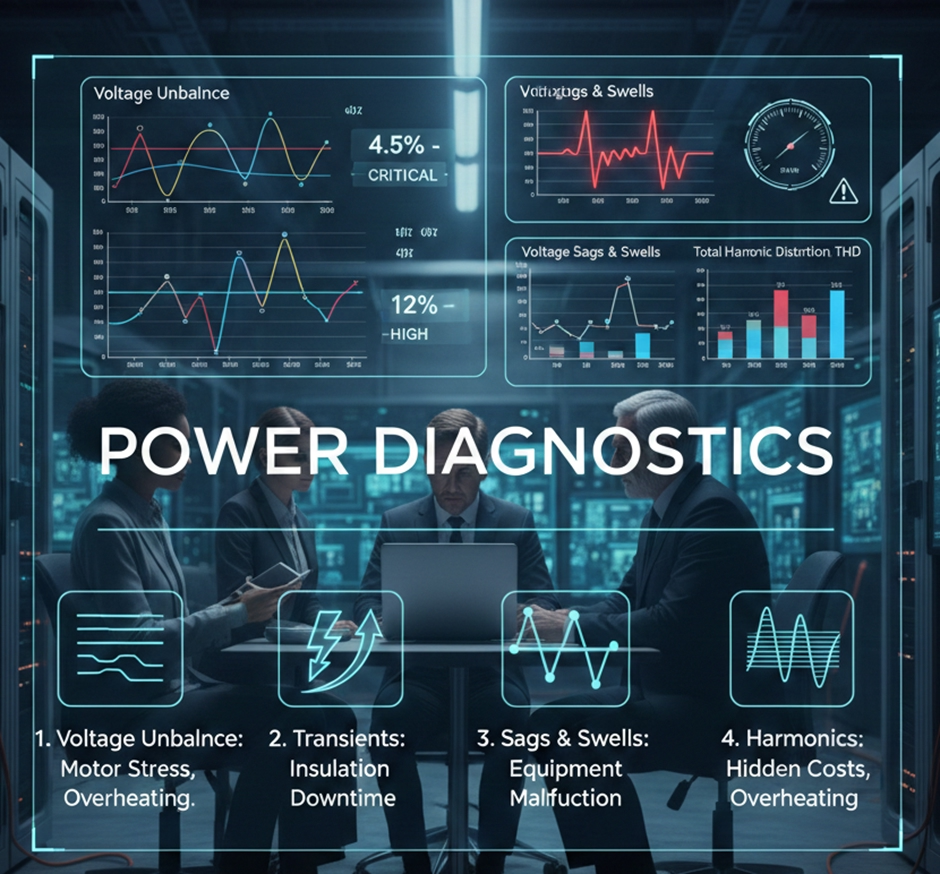
In any process plant, motors, fans, compressors, and drives are exposed to power issues such as sags, swells, harmonics, transients, and unbalance. Monitoring and reporting these events helps plants take corrective action before they create larger failures.
1. Voltage Unbalance: Voltage unbalance measures how equal three-phase voltages are. Higher unbalance shortens the life of three-phase induction motors and leads to current unbalance, vibration, overheating, mechanical stress, and torque pulsation.
Voltage unbalance causes:
- Mechanical stresses in motors due to lower torque output
- Higher current than required in motors and three-phase rectifiers controlling firing angle
- Unbalanced current flowing in neutral conductors in three-phase wye systems
That is why it is important to distribute load equally across phases. Unbalance can also happen because of worn contacts or loose load connections.
2. Transients: Transients are unwanted voltage spikes that may come from plant loads, capacitor bank switching, external disturbances, or environmental events like lightning. A voltage more than 50 V above nominal is generally considered a transient. These short-duration events can badly affect motor insulation and cause unplanned downtime.
3. Voltage Sags: A sag is a reduction in voltage of more than 10% of nominal value for a longer duration. This often happens when large loads such as motors and compressors are turned on or when conductors are undersized.
4. Voltage Swells: Swells are the opposite of sags. They are surges of more than 10% above nominal voltage for longer durations, often due to switching off heavy loads or because of renewable energy sources like solar feeding the system.
5. Harmonics: Harmonics are currents flowing at multiples of the fundamental 50 or 60 Hz frequency. Normal meters often do not capture them, while true RMS meters do. Harmonics can remain unaccounted for and still increase power bills and damage equipment.
- Overheating of fans, motors, transformers, and solenoid valve coils
- Bad operation in electronics control circuits such as PLCs, VFDs, and controllers
- Improper operation of final control elements such as valve coils, heaters, and motor controllers
- Reverse torque in motors, reducing efficiency and causing overheating
Electronic loads usually operate on DC currents and their load patterns are not synchronized with the voltage waveform. These non-linear loads feed harmonics back into the power system.