

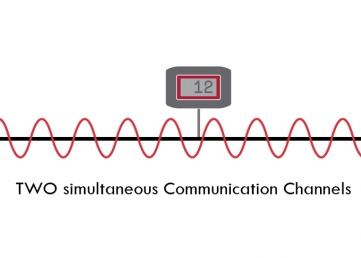
In industrial manufacturing, precision is also a financial necessity. While a valve positioner handles physical movement, the HART protocol provides the intelligence. By layering digital communication over standard 4-20 mA wiring, HART turns a blind mechanical process into a visible, data-driven operation.
1. Seamless Communication via HART 7.0: HART 7.0 enables bi-directional communication between the field device and the DCS or a handheld technician tool. Device Description files make setup more standardized across vendors, and technicians can configure and diagnose valves remotely.
2. Advanced Valve Diagnostics and Predictive Maintenance: HART does not just move the valve, it reports on valve health. The digital data stream supports predictive maintenance by surfacing indicators that would otherwise stay invisible.
- Hunting detection by tracking the number of direction changes
- Seat load leakage estimation based on valve travel behavior
- Operational timeline tracking for usage-based maintenance planning
3. Economic Impact: Smart positioners can consume far less air than traditional E/P positioners. Combined with reduced unscheduled downtime, this often leads to return on investment within 12 to 18 months.
4. Digital Versatility: HART allows digital re-characterization of a valve. Instead of physically changing trim or seat arrangements, engineers can reconfigure valve behavior through the HART interface.
- Linearization of non-linear flow behavior
- Custom curves tuned to process needs without hardware changes
5. High-Precision Feedback: Modern HART positioners often use Hall effect sensors for non-contact feedback. That improves precision by reducing friction and backlash, while the DCS receives more accurate position feedback.
6. Bridging the Gap to Asset Management Systems: A major benefit of HART is integration with asset management systems. Diagnostic data can then support failure pattern recognition, vendor performance visibility, and lower total cost of ownership for costly valve assets.
Conclusion: The HART protocol is more than a communication standard. It elevates the smart positioner into a diagnostic hub and gives operations teams the visibility they need to improve reliability and avoid costly process losses.