

The Highway Addressable Remote Transducer (HART) protocol layers digital communication on top of a 4-20 mA analog signal. While the theoretical maximum transmission distance is around 3,000 meters, real-world performance depends heavily on installation quality.
Key factors influencing transmission distance:
1. Cable Capacitance and the RC Time Constant: Cable resistance and capacitance form a natural low-pass filter. That can absorb the relatively small HART signal, which typically ranges from 20 mV to 600 mV. Capacitance varies widely by cable type, and shielded cables, while useful against EMI, usually have higher capacitance.
2. Installation Quality and Shielding: High-quality shielded cables such as Belden 8760 are recommended for noisy environments, but the shield should be grounded at one end only, usually on the control room side. Grounding at both ends creates a ground loop and can overwhelm the HART signal with 50/60 Hz hum.
3. Line Terminations and Loop Resistance: A HART modem generally needs at least 250 ohm of loop resistance to detect the digital signal. If the total loop resistance climbs to 600-700 ohms because of loose terminals or corroded junction boxes, the field device may lose enough compliance voltage to stop communicating properly.
4. Signal-to-Noise Ratio: HART signals are sensitive. With roughly 500 mV peak-to-peak signal levels, even 100-200 mV of noise can cause communication errors. Typical noise sources include large motors, pumps, VFDs, and nearby high-voltage power lines.
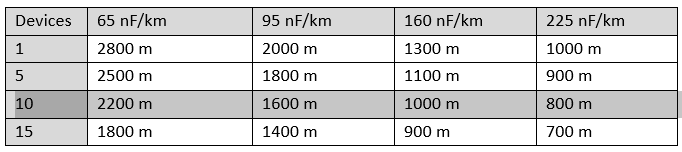
5. Multi-drop Configurations: In multi-drop systems, each added device contributes its own internal capacitance, so the more devices added to a single pair of wires, the shorter the reliable cable length becomes.
Maximum cable length reference table: The following table illustrates how cable capacitance and the number of connected devices impact reliable transmission distance.
Summary: Reliable HART installation requires a complete view of the loop. By choosing low-capacitance cabling, following correct grounding practices, and monitoring total loop resistance, you can improve both distance and reliability.